Research
18
09
The chondroitin sulfate structure and application
Cartilage, as a type of connective tissue widely distributed throughout the animal body, is mainly found in structures such as the articular cartilage, nasal bone, hyoid bone, and trachea. It is composed of chondrocytes and interstitial matrix rich in proteins, minerals, and active components, and has a high processing value. The matrix configuration between chondrocytes is similar to that of a tree, with the main trunk being a long chain of glycosaminoglycans, linked to the trunk are numerous protein chains, and through these protein chains, numerous branches extend outward.
1. What is chondroitin sulfate? (Chondroitin sulfate structure)
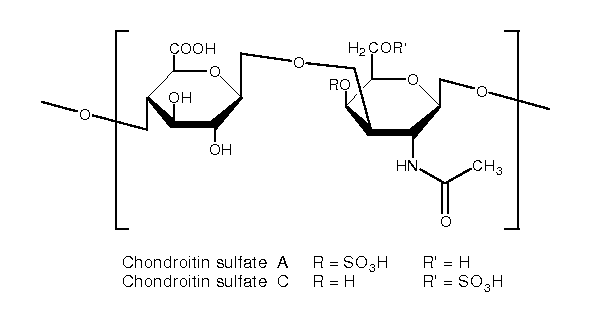
Chondroitin sulfate is a disaccharide unit formed by the linkage of N-acetyl-D-galactosamine and D-glucuronic acid through a β-1,3-glycosidic bond. The disaccharide units are linked together by β-1,4 glycosidic bonds to form a long-chain polysaccharide. The degree of polymerization is usually 45-65, and the molecular weight is typically 4000-40000 Da. This classifies chondroitin sulfate as a biological macromolecule. Due to the structural characteristics of the amino-galactose in its disaccharide units, the sulfate groups can react with the hydroxyl groups and form deep bindings. This structural reorganization between the groups provides chondroitin sulfate with various isomers, including chondroitin sulfate A and chondroitin sulfate C, which are currently widely used in the pharmaceutical industry. Chondroitin sulfate A usually replaces the 4th hydroxyl group of galactose and is mainly found in the joint connections of mammals (cartilage), playing an important role in the biological composition of organisms. Chondroitin sulfate C is abundant in aquatic animals, and the sulfate groups usually replace the 6th hydroxyl group of galactose.
2. A class of large molecules known as glycosaminoglycans
As a type of large molecule of glycosaminoglycans, the sulfate chondroitin sugar chain is covalently linked to the serine residues of the core protein through a tetrasaccharide link region (containing glucuronic acid - galactose - galactose - xylose), forming proteoglycan (CSPG). These molecules play an extremely important role in human neural tissues, such as supporting cell structure and regulating cell activities, and maintaining the development and differentiation of nerve cells.
Sulfated chondroitin proteoglycan is the main component of many neural tissue matrices. These molecules have dual functions in the nervous system: ➡️ On the one hand, they regulate the activity of microglia by binding to receptors, promoting the secretion of nutritional factors;
➡️ On the other hand, their polysaccharide components can inhibit the migration of neural crest cells and protect neurons from damage. Clinical studies have shown that CSPG can enhance the repair ability of nerve cells by regulating tyrosine activity.
3. Application
➡️Pharmaceutical field
Chondroitin sulfate is widely used in the treatment of diseases such as hyperlipidemia, arthritis, and neuralgia. It has functions such as anticoagulation, lowering blood lipids, and protecting the cardiovascular system, and can significantly reduce the incidence and mortality rate of patients with coronary heart disease.
➡️Cosmetics field
Due to its high hydrophilicity, chondroitin sulfate is added to skin care products such as facial cleansers and lotions, which can effectively moisturize, improve skin elasticity, and reduce the formation of wrinkles. Moreover, chondroitin sulfate derived from shark cartilage performs exceptionally well in eye care products, enhancing the water retention effect and clinical data show that it can significantly improve corneal damage.
➡️Biological materials field
Chondroitin sulfate is used to prepare three-dimensional scaffolds, which have good biocompatibility and are suitable for cartilage repair and nerve regeneration. Over time, the biological scaffolds can gradually degrade and be replaced by tissue matrix. Currently, there are studies on new Wollastonite chondroitin sulfate composite scaffolds, chondroitin sulfate composite silk scaffolds, and chitosan-collagen-chondroitin sulfate porous scaffolds, all of which demonstrate good biocompatibility.
➡️Food and health supplement field
Both domestically and internationally, chondroitin sulfate is widely added to food and health supplements to alleviate symptoms such as arthritis, hyperlipidemia, and neuralgia.